Case Studies

Newest first: Fleet Management App, then our latest ride-hailing, multi-vendor ecommerce and laundry delivery builds, and our flagship builds Coin Counter, Bodynetic and the rest of the portfolio. Honest problem/solution write-ups with no invented KPIs. Screenshots live in the portfolio.

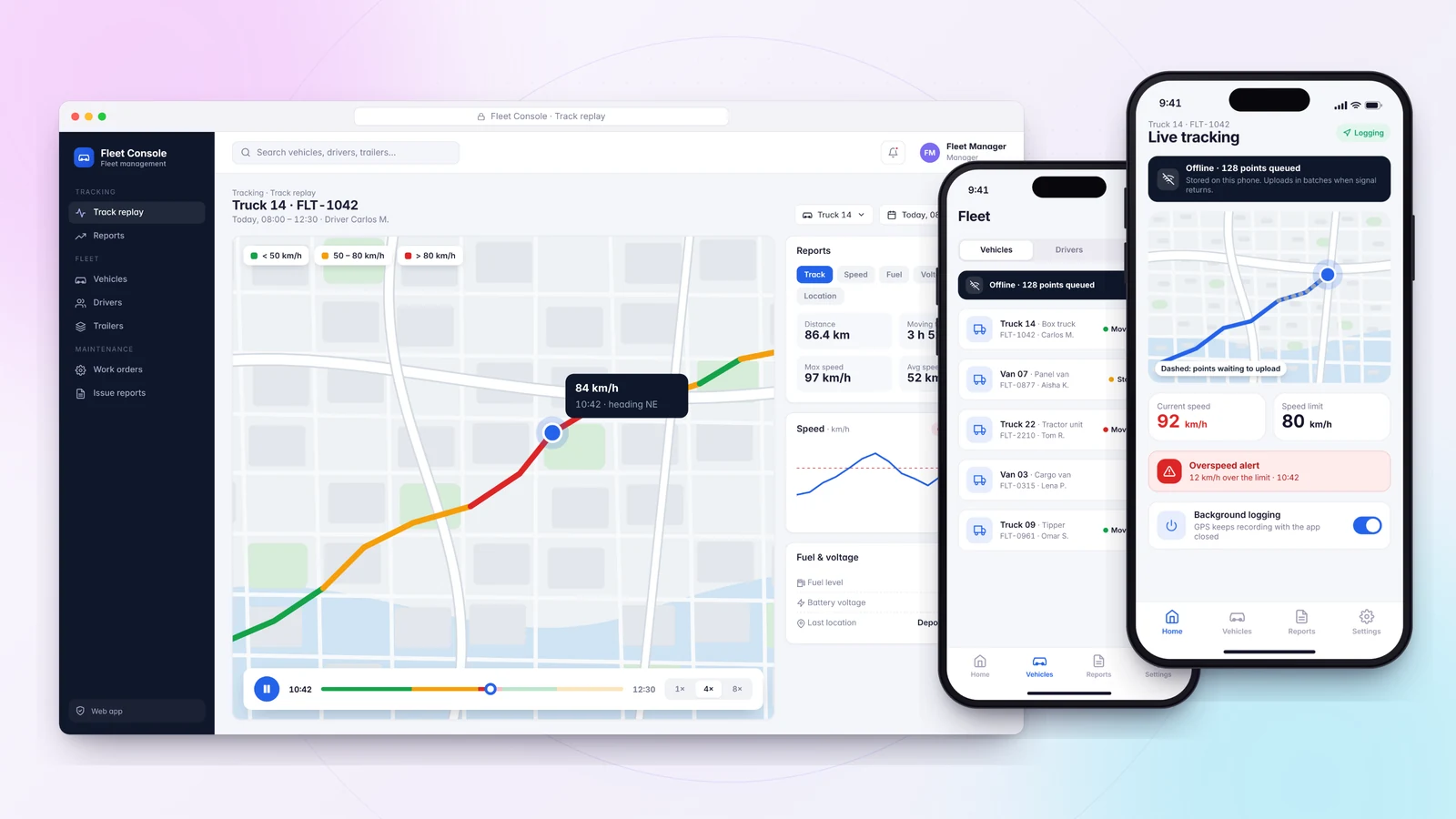
Fleet management app with a web track-replay screen and two phone screens showing GPS logging and offline sync.
Fleet management / field operations

Fleet Management App

The Challenge

A fleet management client needed an app that works where vehicles actually go: on the road, often with weak or no signal. Fleet managers needed to replay where a vehicle had been and how fast it was moving, read fuel, voltage and speed reports, and keep vehicles, drivers and trailers organised in one place. Drivers needed to log GPS from their phone, file work orders and report issues with photos or documents, without losing data when coverage dropped. The client already had its own backend and its own developers, so the app had to fit into an existing platform rather than replace it.

What We Built

We built the app in Flutter for Android, iOS and the web, together with the client's team. Managers get a map view that replays a vehicle's track, with the route coloured by speed and a playback slider to move through the trip, plus reports for track, speed, fuel, voltage and location. Drivers can log live GPS from the phone, including in the background, and an overspeed alert sounds when a set limit is passed. Offline support was a core requirement: GPS points are stored on the device and uploaded in batches once the connection returns, and work orders or issue reports that fail to upload are queued and retried. The mobile version is available on Android, and the app was built with localization support.

  • Vehicle track replay with speed-coloured routes and a playback slider
  • Track, speed, fuel, voltage and location reports with charts
  • Live and background GPS logging from the phone
  • Overspeed alert
  • Offline storage with batched upload on reconnect
  • Work orders and issue reports with photo, video and document scan
  • Vehicle, driver and trailer management with bulk import
  • Sign-up with OTP verification
  • Localization support
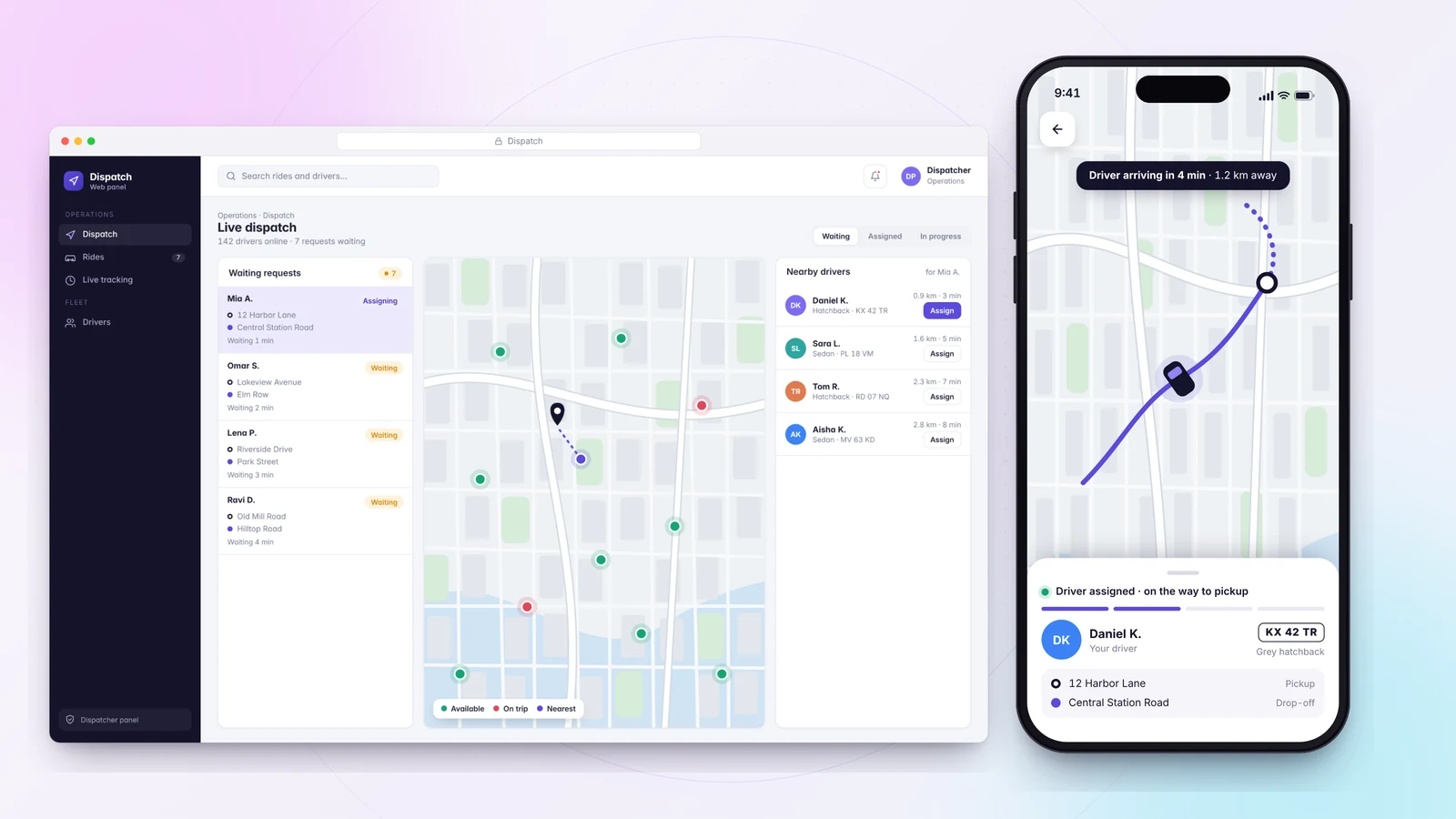
Dispatcher web panel with live drivers on an abstract map beside a phone tracking an assigned driver
Ride-hailing / on-demand delivery

Ride-Hailing and Delivery Platform

The Challenge

A ride-hailing and delivery client wanted to launch a full platform without a ground-up build. The platform they chose already covered the core flows, but out of the box it did not look or behave the way they needed for launch. The passenger and driver apps needed a clear, consistent interface, and the backend needed fixes before it could be trusted with real riders and drivers. They needed a team to customise it, fix it and get it deployed.

What We Did

We customised and deployed the platform end to end: the passenger app, the driver app, the backend and the dispatcher web panel. On the apps, we made UI changes and polished the passenger and driver experiences. On the backend, we fixed issues that affected reliability so the platform could run day to day. Operators dispatch rides and assign them to drivers from the dispatcher web panel, and passengers follow the assigned driver live on a map.

  • Ride dispatch from a dispatcher web panel
  • Ride assignment to drivers
  • Live map tracking of the assigned driver for passengers
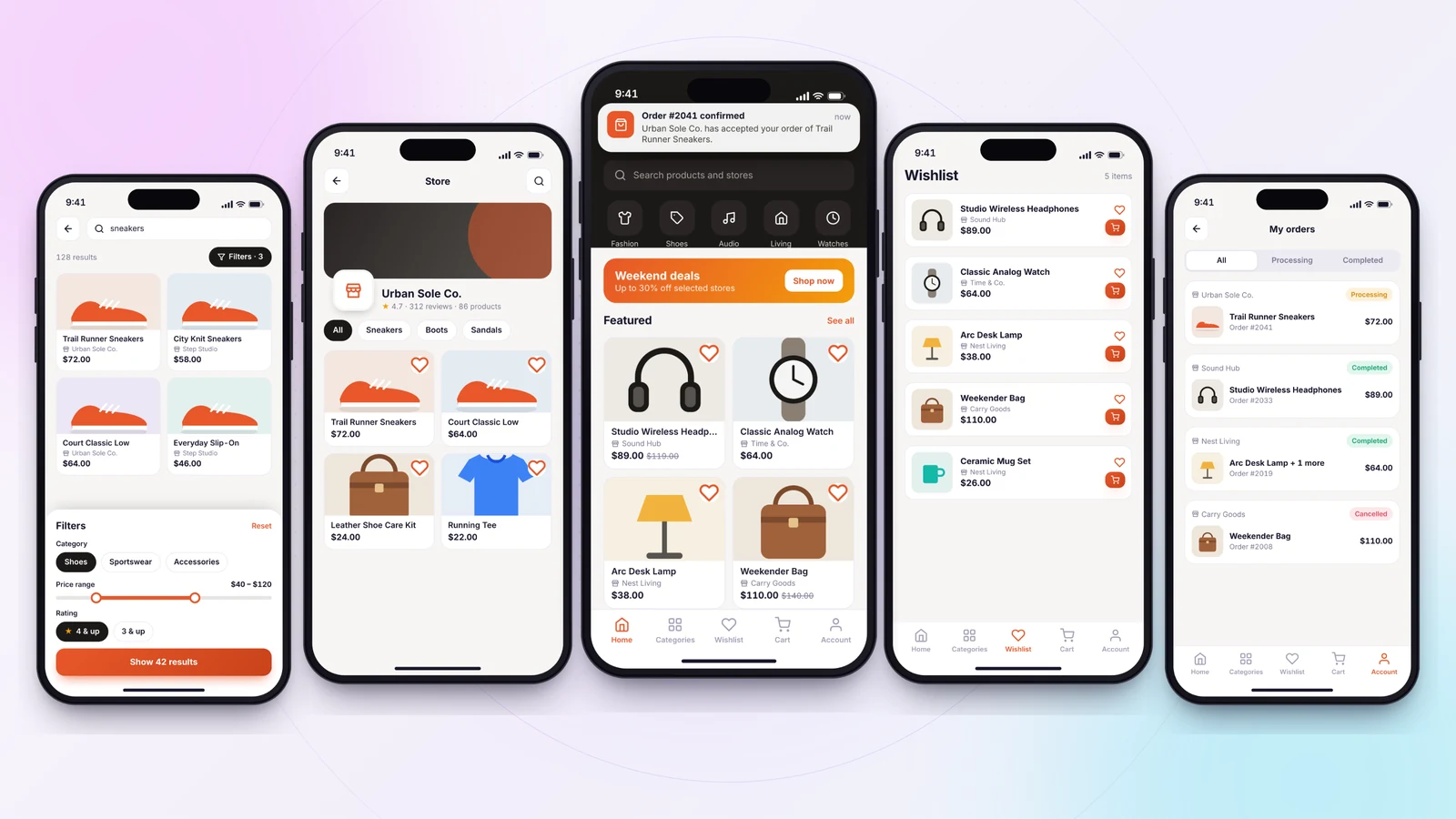
Multi-vendor shopping app on five phones showing search filters, a vendor store, a notification, a wishlist and orders.
Ecommerce / multi-vendor marketplace

Multi-Vendor Ecommerce Marketplace App

The Challenge

An ecommerce client ran a multi-vendor marketplace on WordPress with WooCommerce and Dokan, with many vendors listing products, and it already had a mobile app. Shoppers expect to filter products by size, colour and other variations, browse by seller, save favourites, apply coupons and pay the way they prefer, including cash on delivery. The app needed a team to take it over and revamp it, while keeping it working with the existing catalog and order system.

What We Built

We took over the existing Flutter app for Android and iOS and revamped the whole mobile app, redesigning and reworking it on top of the client's existing WooCommerce and Dokan backend. The backend and the original app were already in place before we joined; our work is the mobile app revamp and the releases since. Shoppers browse the catalog with product variations and filters, search, keep a wishlist, and check out with coupons, cash on delivery or online payment gateways. Vendor storefronts let shoppers browse by seller, and the cart groups items by store. Sign-in works with Google, Facebook, Apple or a phone number, and push notifications keep shoppers informed about their orders. The app has localization support.

  • Product catalog with variations and filters
  • Search and wishlist
  • Cart grouped by store, with coupons
  • Cash on delivery and online payment gateways
  • Order history
  • Vendor storefronts
  • Push notifications
  • Google, Facebook, Apple and phone sign-in
  • Localization support
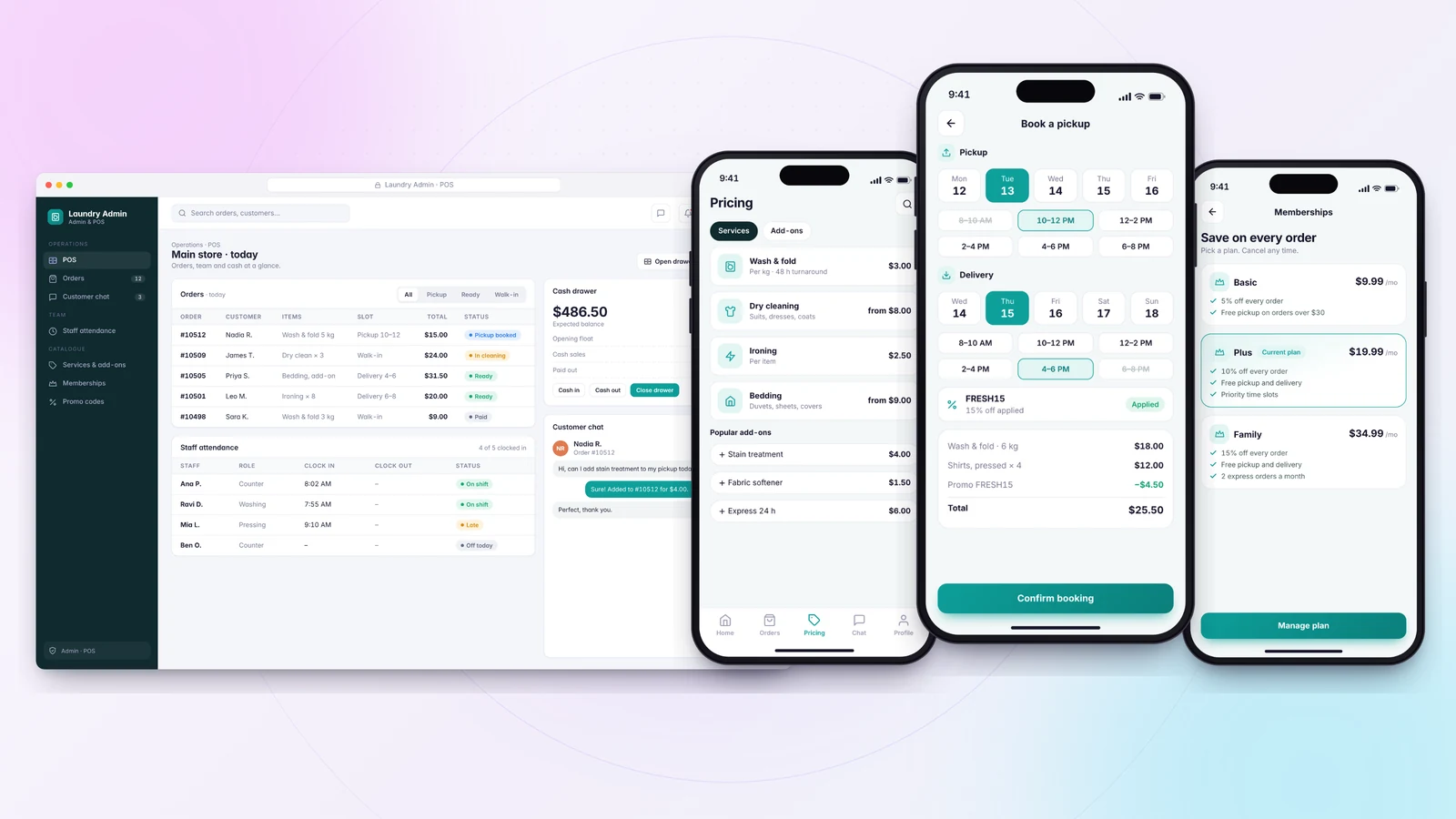
Laundry pickup and delivery app with an admin point-of-sale screen beside phones showing prices, time slots and memberships.
Laundry / on-demand local services

Laundry Pickup and Delivery Platform

The Challenge

A laundry service client wanted customers to book pickup and delivery online instead of by phone, while the shop kept control of how many orders it could handle each day. Pickup and delivery windows had to respect daily capacity and holidays, service had to be limited to the areas the business actually covers, and pricing had to handle add-ons, promo codes and memberships. At the counter, staff needed a point-of-sale tool for walk-in orders, plus a simple way to track attendance and the cash drawer.

What We Built

We built the platform in four parts: a customer website, a Flutter mobile app, an admin panel and a separate POS app for the counter. Customers sign in with a one-time code, pick a pickup and delivery slot, add services and add-ons, apply a promo code and pay by card. They can cancel, reschedule or reorder a past order in a few taps, download PDF invoices and chat with the business. Admins set slot limits per day, block holidays, define the service areas the business covers, and manage pricing, promos and memberships. Push notifications keep customers updated as orders move along.

  • Pickup and delivery booking with time slots
  • Cancel, reschedule and reorder
  • Daily slot limits and holiday calendar
  • Service areas set by the admin
  • Pricing with add-ons, promo codes and memberships
  • OTP sign-in
  • Card payments with PDF invoices
  • Order history with order statuses
  • Customer to admin chat
  • Push notifications
  • Admin panel
  • POS with staff attendance and cash drawer
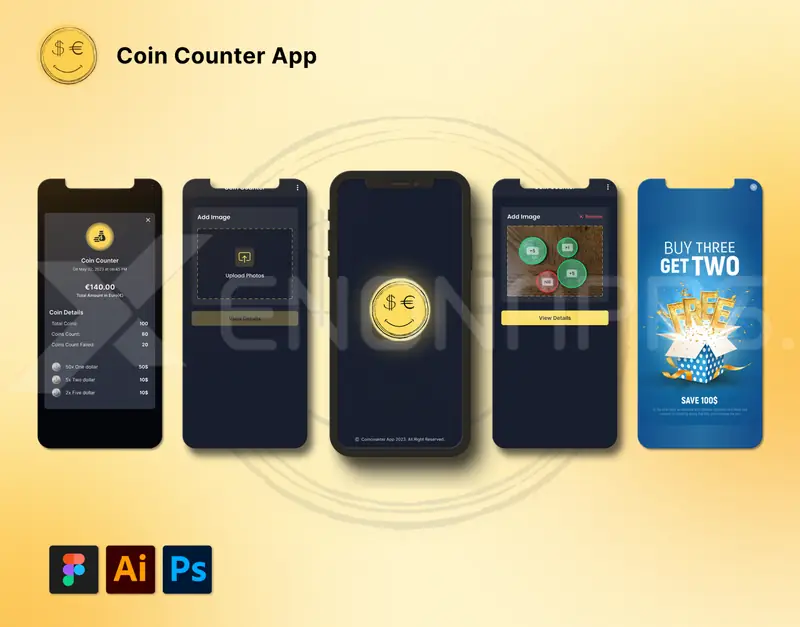
Coin Counter app screens
Computer Vision · Utility

Coin Counter

The Challenge

Counting large volumes of coins by hand is slow and error-prone — a daily grind for cashiers, small businesses, and collectors. Hardware coin counters solve it, but they are expensive, stationary, and overkill for most users. The idea: turn the phone people already carry into the counting machine. Worn coins, overlapping piles, and harsh indoor lighting defeat demos trained only on neat studio photos. Cashiers also need offline continuity when till-area connectivity drops mid-count. Real tills add motion blur from hurried hands, mixed lighting across store brands, and staff who will abandon any flow that needs a training seminar before the first count.

What We Built

We built a mobile app that uses the device camera and on-device image recognition to identify, classify, and count coins in real time. Point the camera at a pile of coins and the app detects each denomination, keeps a running total, and lets the user save or share counts. The recognition pipeline was tuned for overlapping coins, varied lighting, and worn faces — the messy conditions real users actually shoot in. We focused on resilient capture guidance, offline-capable counting flows, and save or share paths for shift handoffs—without publishing invented accuracy marketing numbers. We invested in capture guidance, offline persistence, and honest uncertainty states, then validated on messy partner samples instead of only studio decks.

  • Real-time coin detection and classification through the camera
  • Per-denomination totals with saved count history
  • On-device processing — works without a connection
  • Built for iOS and Android
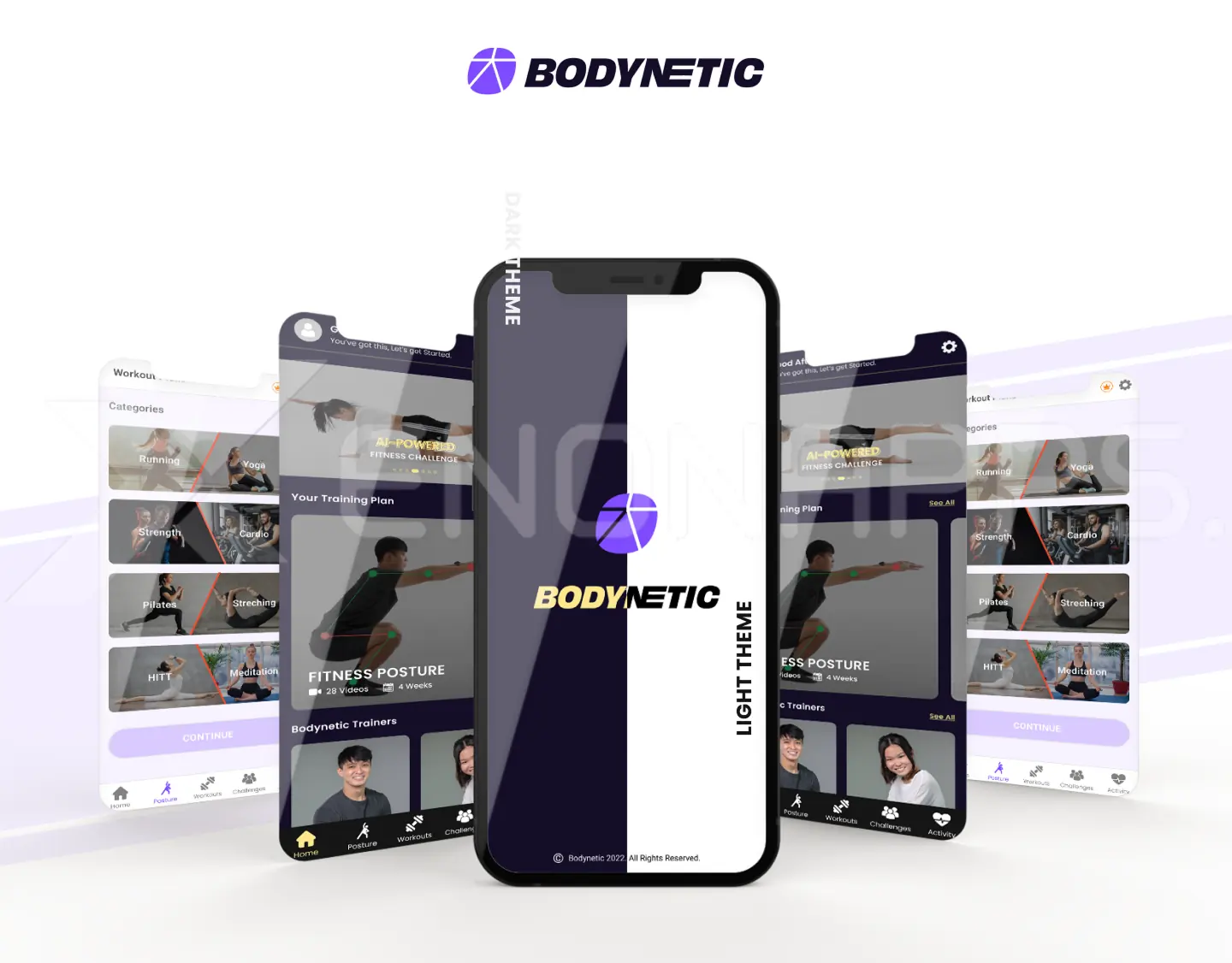
Bodynetic app screens
Health & Fitness · AI

Bodynetic

The Challenge

Poor posture is one of those problems everyone has and no one tracks — and correcting it normally requires a trainer or physiotherapist watching you. The goal: put that supervision in the phone. Gym environments add glare, occlusion, and interrupted attention—so the product had to fail gracefully when the model was unsure instead of inventing false confidence. Athletes abandon coaching apps that feel like paperwork before a set, and they distrust cues that sound confident when the camera view is partial. Gym lighting, mirrors, and crowded floors make computer-vision demos from clean studios misleading. The product also had to respect privacy instincts—many users will not accept shipping every frame to a remote GPU without a clear reason. Beyond the camera loop, Bodynetic had to decide what not to ship: no trainer marketplace in v1, no calorie theater, and no silent cloud fallback that surprised privacy-sensitive athletes. The hard product problem was translating pose estimates into coaching language people trust under fatigue—short cues, honest uncertainty, and a session rhythm that matches how sets actually happen on a gym floor.

What We Built

Bodynetic uses AI-powered pose detection through the phone camera to spot bad posture and guide the user toward correcting it. The app analyzes body position in real time, flags misalignment, and walks users through corrective feedback — an expert eye, available anywhere. We designed explicit fallback copy and coaching cues for low-confidence moments, and kept model updates as a deliberate release path rather than a silent surprise. We prioritized a short session setup, high-contrast glanceable cues, and explicit low-confidence fallbacks. On-device inference was treated as a product requirement where feasible, with a deliberate model-update channel instead of silent swaps. Progress history emphasized honest practice logs rather than vanity streaks. Trainer-marketplace ideas stayed out of v1 to keep it focused. Delivery emphasized a prototype-first path: validate pose detection on real gym footage early, time session setup with athletes, then harden lighting and occlusion cases before store packaging. Architecture notes and a model-update runbook were treated as handover artifacts so the coaching loop could be maintained without tribal knowledge. Qualitative success meant athletes finished setup without abandoning and understood cues without needing a trainer to interpret the screen.

  • Camera-based pose detection and posture analysis
  • Real-time misalignment flags with corrective guidance
  • Progress-oriented, coach-style feedback loops
  • On-device AI for responsive, private analysis
Pharmassist Rider app screens
Healthcare · Logistics

Pharmassist Rider

The Challenge

Medicine delivery is logistics with higher stakes: orders must reach the right person, on time, with a clear record of every handoff. Pharmacies needed a dependable rider-side platform for doorstep delivery of online medicine orders. Riders cannot navigate deep menus in traffic, and status language that mismatches pharmacy ops creates support chaos. Confirmation evidence must be practical without overclaiming compliance certifications. Peak delivery windows compress patience for UI mistakes, and mismatched status words between pharmacy staff and riders create duplicate support threads.

What We Built

We built the rider app powering the delivery leg: incoming order queues, pickup and drop-off details, live status updates through each stage of the run, and delivery confirmation at the door. The interface is deliberately simple — riders use it on the move, one-handed, often in traffic. Glanceable queues, ops-aligned status vocabulary, and doorstep confirmation history shaped the build. HIPAA-aware topics—logging, media storage, access—were discussion starters in discovery. We optimized for glanceable queues, shared lexicon, and practical confirmation history, with HIPAA-aware discovery questions documented as open risks—not marketing seals.

  • Order queue with pickup and delivery details
  • Stage-by-stage status tracking per delivery
  • Delivery confirmation and history
  • Simple, glanceable UI designed for use on the road
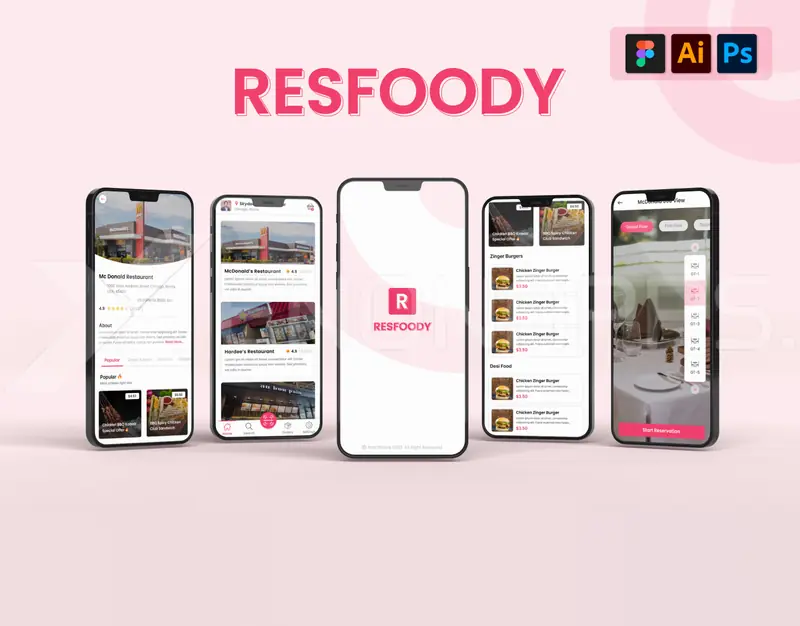
Resfoody app screens
Food & Beverage · SaaS

Resfoody

The Challenge

Food and beverage venues juggle reservations, menus, and orders across tools that rarely stay in sync. Guests expect a smooth reservation path; operators need the same data on mobile and back-office — not a one-restaurant point solution that breaks when a second venue opens. Guest booking paths and kitchen reality diverge quickly when menus and reservations live in disconnected tools. Multi-venue operators need isolation without forking a codebase per location. When guest channels and kitchen tools disagree on availability, venues bleed goodwill faster than engineering can ship another theme tweak.

What We Built

We built Resfoody as a cloud platform for the food and beverage sector with a mobile-first experience: reservation and ordering flows, menu and catalog management, and operational views that stay in sync across devices. Shared infrastructure keeps venues isolated while the product stays ready to onboard the next location. Unified guest booking with ops-facing order and menu sync, plus per-venue isolation on shared infrastructure. We unified guest booking with ops menu truth and designed multi-venue isolation so openings reuse configuration. Peak and localization QA scenarios were first-class.

  • Reservation and booking flows for food & beverage venues
  • Menu, catalog, and order management
  • Real-time sync between mobile and back office
  • Multi-venue architecture ready to onboard new locations
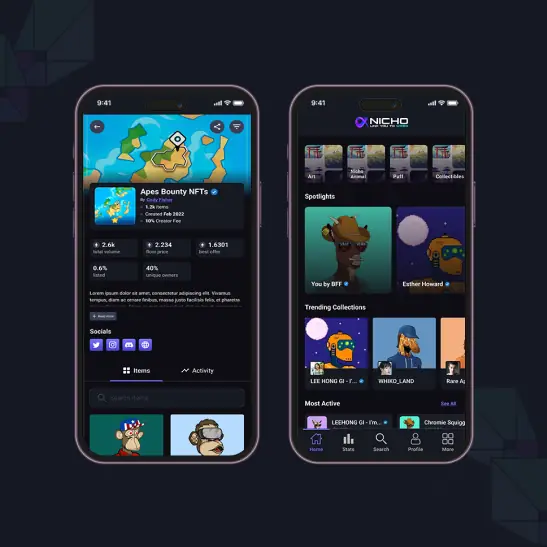
Nicho NFT Marketplace app screens
Web3 · Marketplace

Nicho NFT Marketplace

The Challenge

An NFT marketplace lives or dies on trust and browsing experience: users need to discover collections quickly, evaluate assets with confidence, and transact without friction — all in a space where a clumsy wallet flow loses the sale.

What We Built

We delivered a mobile marketplace for discovering, collecting, and selling NFTs. The app pairs a fast, media-heavy browsing experience — trending collections, spotlights, artist profiles — with clear asset detail pages showing pricing, activity, and ownership history, plus streamlined listing and purchase flows designed to keep transactions moving.

  • Collection discovery with trending and spotlight feeds
  • Asset pages with pricing, bids, and activity history
  • Listing and purchase flows built for mobile
  • Media-heavy UI tuned for smooth scrolling
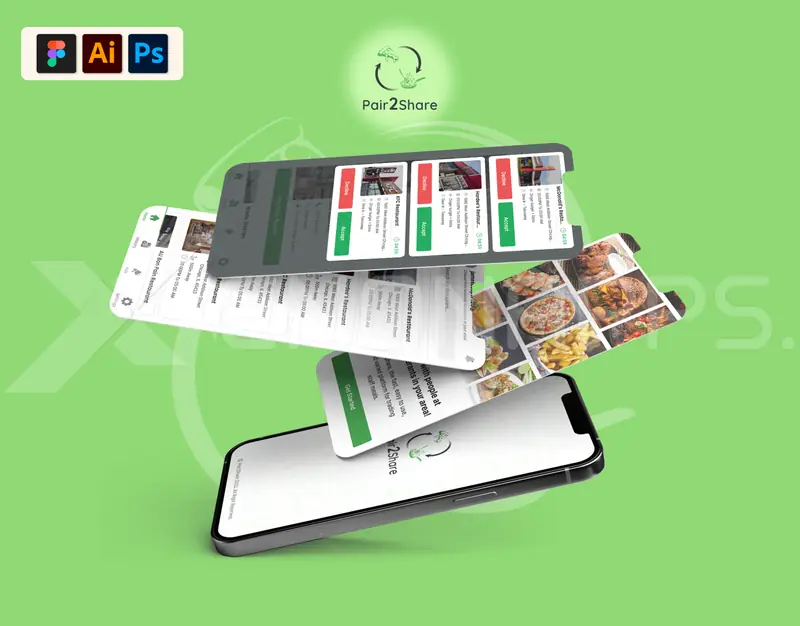
Pair2Share app screens
Food Service · Marketplace

Pair2Share

The Challenge

Restaurant and café staff often receive free staff meals they cannot use — while workers at nearby eateries want a meal they did not get. There was no simple way to trade those unused meals across venues.

What We Built

We built Pair2Share as a mobile platform where staff can list free staff meals and claim offers from workers at separate eateries. The product focuses on clear listings, matching nearby offers, and a lightweight claim flow so busy shift workers can complete a trade without a heavy checkout experience.

  • Staff meal listings across participating eateries
  • Browse and claim offers from nearby venues
  • Lightweight mobile flows for on-shift use
  • Marketplace pattern tuned for food-service staff
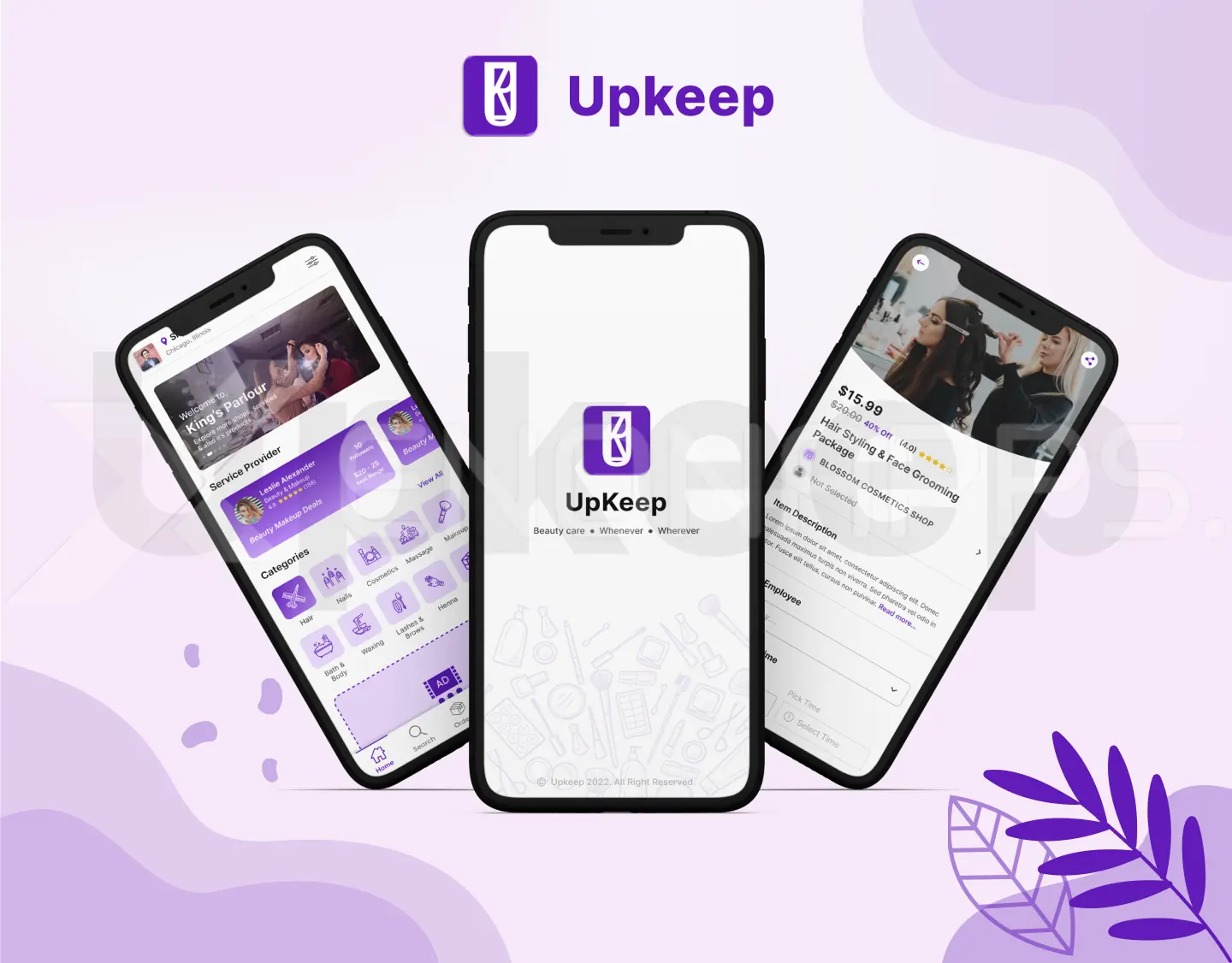
Upkeep app screens
Beauty & Wellness · Marketplace

Upkeep

The Challenge

Regional beauty and cosmetics services are scattered across DMs, phone books, and one-off bookings. Customers struggle to find trusted providers nearby; providers and partners lack a shared place to manage demand. Upkeep needed one mobile platform that connects all three — customers, service providers, and partners — without turning every booking into a custom ops chore.

What We Built

We built Upkeep as a beauty-care marketplace app for the region: discovery and booking for customers, provider-facing flows for services and availability, and partner touchpoints so the network can grow from one product surface. The UI stays mobile-first so bookings and day-of coordination happen on the phone people already carry.

  • Customer discovery and service booking
  • Provider-side service and availability management
  • Partner onboarding on the same platform
  • Mobile-first UX for beauty and wellness services
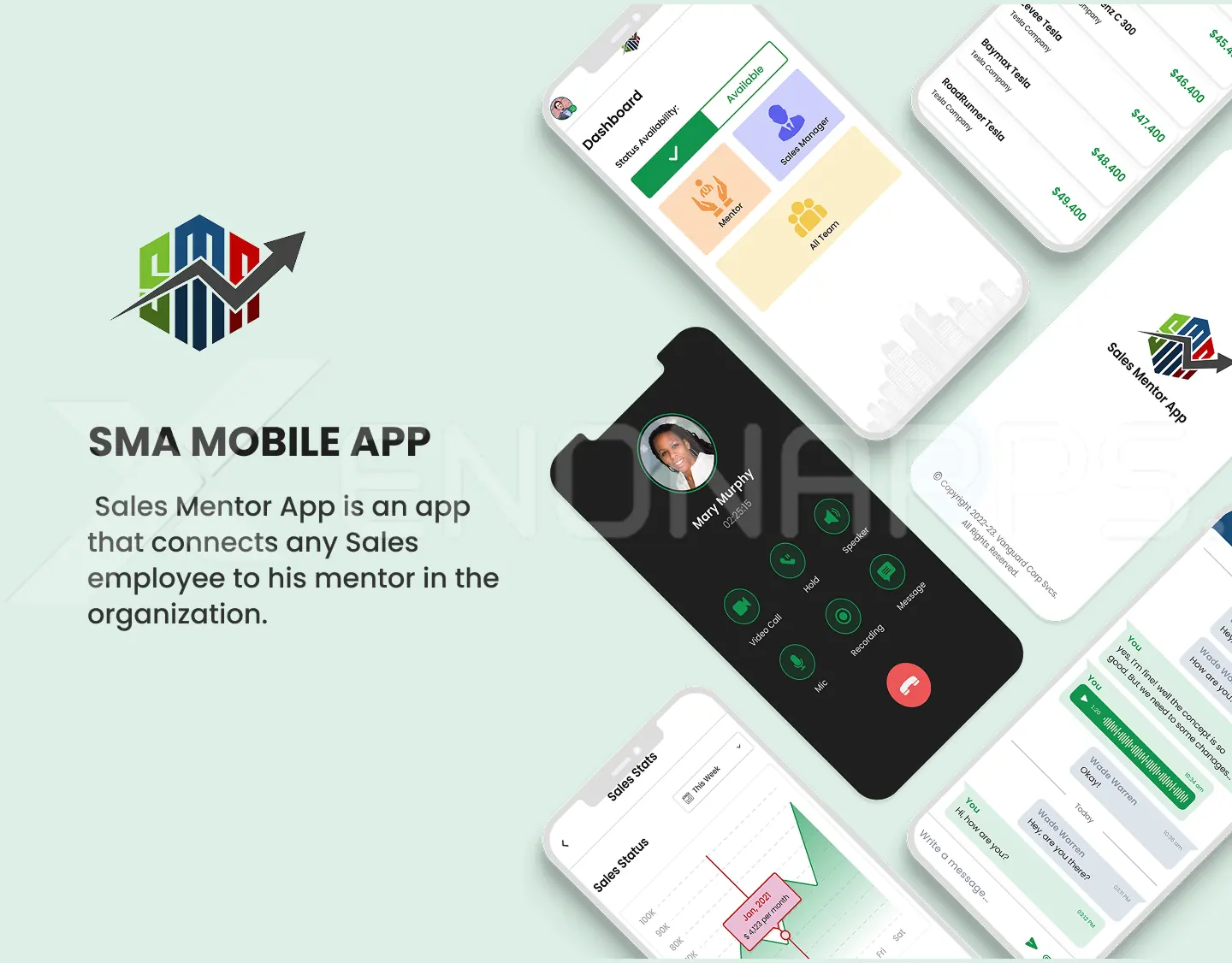
Sales Mentor app screens
Sales Enablement · SaaS

Sales Mentor

The Challenge

Sales teams grow faster than mentorship bandwidth. New and mid-level reps need reliable access to mentors for coaching, but calendars, chat threads, and weekly performance views live in different places — so coaching becomes inconsistent and hard to track.

What We Built

We built Sales Mentor to connect any sales employee to their mentor inside the organization: see availability, jump on calls, chat when async is enough, and keep weekly sales stats in view so coaching stays tied to real activity — not vague check-ins.

  • Mentor–rep pairing inside the organization
  • Availability, calls, and chat in one place
  • Weekly sales stats for coaching context
  • Built for day-to-day sales enablement on mobile
Kaprapur app screens
Fashion · Ecommerce

Kaprapur

The Challenge

Fashion shoppers expect mobile-native browsing for men, women, and kids — product discovery, cart, and checkout that feel fast — plus a sell flow for sellers who list inventory from their phone.

What We Built

We delivered Kaprapur as a fashion ecommerce app covering product listings across categories, cart and purchase flows, and a sell path for listing items. The UI keeps catalog browsing and seller actions on the same mobile surface so buyers and sellers share one coherent experience.

  • Category browsing for men, women, and kids
  • Product detail, cart, and purchase flows
  • Seller listing / sell flow on mobile
  • Ecommerce UX tuned for fashion catalogs
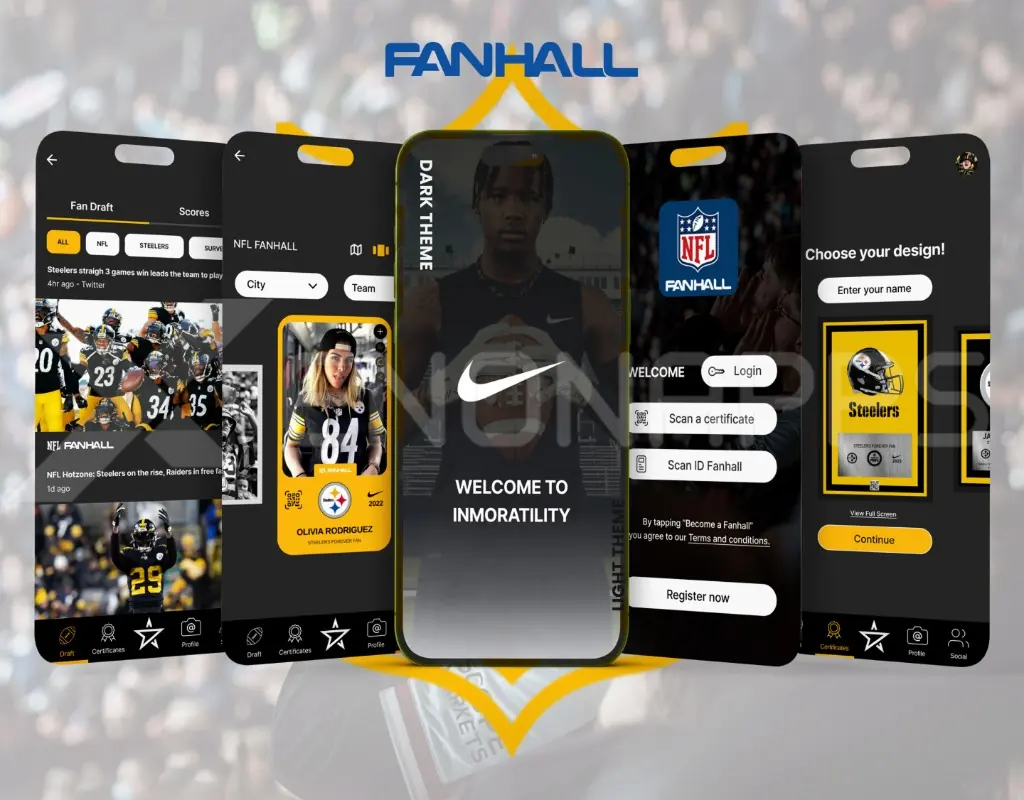
FanHall NFL app screens
Sports & Media

FanHall NFL

The Challenge

NFL fans bounce across apps for scores, news, highlights, and team identity. FanHall wanted one fast destination — breaking news, real-time scores, player highlights, and fan IDs — without forcing fans to live in a dozen tabs on game day.

What We Built

We built a sports media app around speed: a real-time score center, curated breaking-news feeds, player highlight reels, and fan ID surfaces in a swipe-friendly layout. Push notifications keep fans in the game without constant open sessions, and the content pipeline is structured for game-day traffic spikes.

  • Real-time scores and game tracking
  • Breaking news feeds with push notifications
  • Fan ID surfaces and player highlights
  • Built for game-day traffic patterns

Every project here followed the same playbook: a scoping call, a fixed-milestone plan, agile sprints with demos, and a documented handover.

See how we work

Your product could be next

Tell us what you are building. Free scoping call—call, email, or send a short brief.